
Phorid Flies
How to Identify Phorid Flies, Why They Appear, and How to Eliminate the Infestation
Phorid flies are small, fast-moving pests often found in kitchens, bathrooms, and areas with hidden organic buildup. Unlike fruit flies, they prefer decaying material in drains, garbage, and even beneath floors, making infestations harder to locate and eliminate.
Correct identification is critical. Phorid flies are frequently mistaken for fruit flies or fungus gnats, but their behavior is distinctly different. Instead of hovering, they tend to run across surfaces in quick, erratic bursts.
Understanding where phorid flies breed and how they behave is key to stopping an infestation at its source—especially since their breeding sites are often hidden from view.

Also Known As
Phorid flies are commonly referred to as scuttle flies, humpbacked flies, and coffin flies. These names reflect their behavior, physical appearance, and breeding habits. In some cases, they are also called sewer flies due to their attraction to contaminated, decaying material.
Scuttle Flies
Named for their distinctive habit of running rapidly across surfaces rather than taking flight when disturbed.
Humpbacked Flies
Refers to their prominently arched thorax, which gives them a recognizable humpbacked profile.
Coffin Flies
A nickname earned from their ability to breed in decaying organic matter, including extreme environments such as buried remains.
Sewer Flies
Sometimes used because they are attracted to rotting material and buildup in drains, plumbing, and sewer systems.
Phorid flies are often confused with fruit flies or drain flies, but can be identified by their rapid, erratic “scuttling” movement.
Quick Identification: Is This a Phorid Fly?
If the small flies in your home match the characteristics below, you are most likely dealing with phorid flies.
-
Very small — typically about 2-4 mm long
-
Light brown to dark tan body with a distinct humpbacked shape
-
Runs in quick, erratic bursts across surfaces instead of hovering
-
Frequently found near drains, garbage, or hidden organic buildup
-
Strong attraction to decaying material, not just fruit
-
Appear suddenly and persist even after cleaning visible surfaces
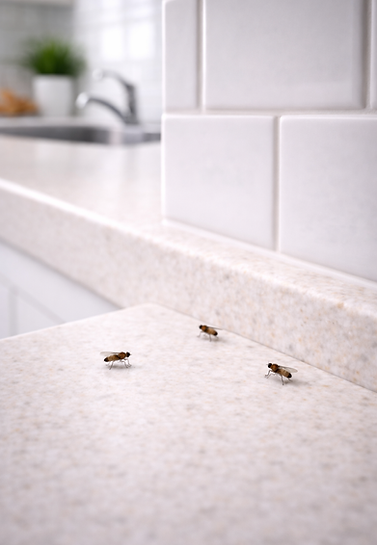
Phorid flies (Phoridae family), often called “scuttle flies,” are small insects measuring approximately 2-4 millimeters in length. They are typically light brown to tan and are most easily recognized by their distinct humpbacked thorax and their habit of running across surfaces rather than hovering.
These flies are commonly found in areas where decaying organic material is present—especially in drains, garbage containers, recycling bins, and other locations where buildup may not be immediately visible. Unlike fruit flies, which are drawn to exposed produce, phorid flies often originate from hidden sources such as pipe residue, subfloor contamination, or trapped debris.
Because phorid flies are highly sensitive to the chemical signals released during decomposition, they are able to locate breeding sites that are out of sight. This makes infestations particularly frustrating, as the visible flies are often far removed from the actual source.
Once established, phorid flies reproduce rapidly, and their populations can expand quickly if the breeding site remains undetected and untreated.
What Is a Phorid Fly?
Where Phorid Flies Come From
Phorid flies originate from decaying organic material, but unlike fruit flies, their breeding sources are often hidden from view.
Common sources include:
-
Drain buildup (biofilm inside pipes)
-
Garbage cans and liners with residue
-
Recycling bins with organic waste
-
Food trapped under appliances (refrigerators, dishwashers)
-
Moist areas beneath flooring or inside walls
-
Sewage leaks or plumbing issues
Because these breeding sites are frequently concealed, simply cleaning visible surfaces often has little effect.
But you don’t have to find the source first to stop the problem. By targeting active adult flies, you can begin breaking the reproduction cycle and reducing the infestation immediately.


Phorid fly infestations persist because they are supported by hidden breeding sources that continue producing new flies over time.
But here’s what most people don’t realize:
You don’t have to find the source first to stop the infestation.
Phorid flies depend on a continuous cycle of adult reproduction. If that cycle is interrupted, the population cannot sustain itself.
By targeting and eliminating active adult flies, you:
-
Prevent new eggs from being laid
-
Collapse the reproductive cycle
-
Drive the population down rapidly
As the cycle breaks, the infestation doesn’t just slow—it begins to die out.
This allows you to eliminate the problem at its source—even when that source isn’t immediately visible.
Why Phorid Fly Infestations Grow So Quickly
The rapid growth of phorid fly populations becomes easier to understand when you look at their full life cycle.
The Life Cycle of the Phorid Fly

Phorid flies reproduce quickly—and that’s what makes infestations so persistent.
A single female can lay eggs in hidden organic material, where the larvae develop out of sight. Within days, those larvae mature into new adult flies, ready to continue the cycle.
The full life cycle can complete in as little as 7–14 days, allowing populations to grow rapidly if left unchecked.
But here’s what matters most:
Phorid flies rely on continuous reproduction to survive.
If that cycle is interrupted—by targeting and removing adult flies before they can reproduce—the infestation begins to collapse.
-
Eggs are laid in hidden organic material
-
Larvae develop out of sight
-
New adults emerge in days
-
The cycle repeats rapidly
Break the cycle—and the infestation cannot continue.
How to Stop a Phorid Fly Infestation
Stopping a phorid fly infestation starts with disrupting the one thing the population depends on: reproduction.
While eggs and larvae remain hidden in organic material, adult flies are the only stage you can reliably target. By removing them before they reproduce, you prevent new generations from forming.
That’s how the cycle is broken.
Effective control focuses on reducing the active adult population quickly and consistently. As fewer adults remain, fewer eggs are laid, and the infestation begins to decline.
-
Target active adult flies
-
Reduce reproduction at the source
-
Prevent new generations from forming
-
Continue until activity drops to zero
In many cases, this approach allows you to stop the infestation without needing to locate or remove the hidden breeding site immediately.
Stop the adults—and you stop the infestation.

A Phorid Fly Solution Is Coming Soon
Phorid flies require a different approach—and we’re building a solution designed specifically for them.
If you want early access or would like to help shape the product before launch, you can get involved today.